Adjustable Dumbbells vs Fixed Dumbbells: Cost, Space & Workout Compared (2026)
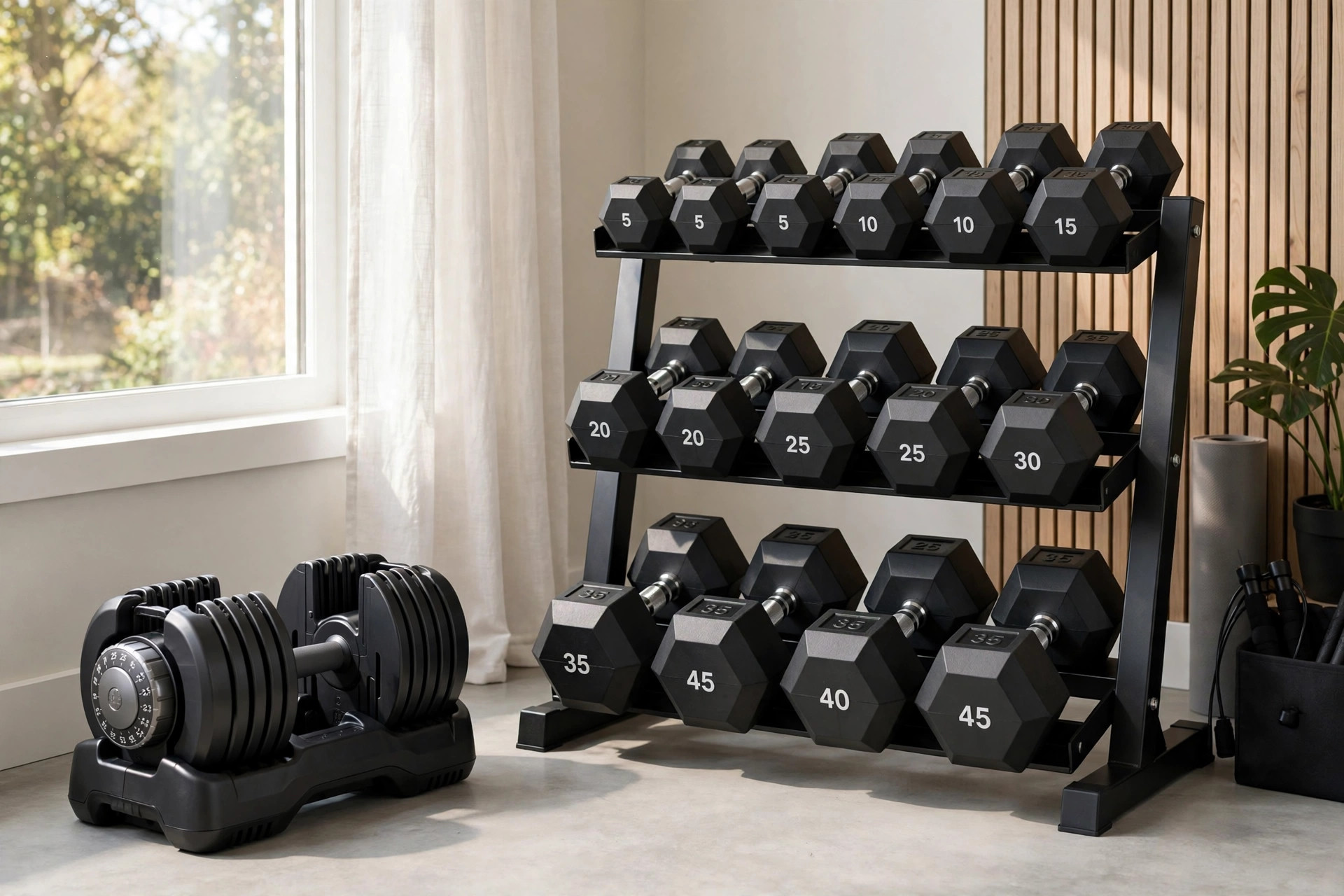
Every home gym builder hits this fork in the road. Adjustable dumbbells promise a full weight room in two square feet. Fixed dumbbells promise the feel of a commercial gym and nothing to break. Both claims are mostly true, which is why the choice is harder than it looks.
This guide compares the two types on the four things that matter: cost, space, workout experience, and durability. No brand loyalty, no sponsored picks. At the end you will know which type fits your situation, with real 2026 prices to back it up.
Quick verdict
For most home gyms, adjustable dumbbells are the better buy. A $399 pair covers the same 5–50 lb range as a fixed set costing $700 or more, and it fits in a corner instead of against a wall. Fixed dumbbells are the better choice if you have a garage or dedicated room, train heavy enough to need 60+ lb pairs, or do drop sets where you need to grab the next weight in two seconds. Neither type builds muscle faster. Your muscles respond to resistance and progression, not to the shape of the handle.
Cost comparison
The math favors adjustables by a wide margin. To cover 5–50 lbs per hand in 5-lb steps with fixed dumbbells, you need ten pairs. That is 550 lbs of iron. Budget rubber hex sets (Amazon Basics, CAP) run roughly $400–$700 for the full set. Mid-tier sets from Body-Solid or York run $1,100–$1,200. Premium sets from Rogue or REP push past $1,500. Then you need a rack, since 550 lbs of dumbbells cannot live on the floor. A decent 3-tier rack adds $200–$300.
An adjustable pair covering the same 5–50 lb range costs $360–$770 depending on the model. The Core Home Fitness twist-lock pair runs about $360–$400. The PowerBlock Elite EXP runs about $399. The Nuobell 580, which extends to 80 lbs, runs about $745–$769. Storage cradles come in the box, so there is no rack to buy.
Put side by side, the cheapest reputable adjustable ($360) undercuts the cheapest full fixed set ($400) before you even count the rack. At the mid-tier, a $399 PowerBlock replaces a $1,200 Body-Solid set plus a $250 rack. The gap narrows only if you buy fixed dumbbells piecemeal, a few pairs at a time, which many lifters do. Three pairs (15, 25, 40 lbs) cost around $150–$250 and cover a surprising amount of training. But the moment you want the full range, adjustables win on price.
| Adjustable (5–50 lb) | Fixed hex set (5–50 lb) | |
|---|---|---|
| Equipment cost | $360–$770 / pair | $400–$1,200+ / 10 pairs |
| Rack / storage | Included cradles ($0) | 3-tier rack ($200–$300) |
| Total to cover 5–50 lb | $360–$770 | $600–$1,500 |
| Cost per lb of iron | N/A (mechanism, not iron) | ~$0.70–$2.20 / lb |
| Expand later | Expansion kits ($199 each) | Buy more pairs |
Prices are typical US street prices observed in 2026 and move with sales. Fixed-set pricing varies widely by brand; budget sets cluster near $1/lb, premium sets near $2/lb.
Space requirements
This is where adjustables dominate. A pair of adjustables in their cradles occupies about two square feet of floor. The PowerBlock Elite EXP measures 16 by 6.3 inches per dumbbell. The Nuobell 580 measures 17 by 7.5 inches. You can slide them under a desk, into a closet, or against any wall. They work in apartments, bedrooms, and home offices.
A fixed 5–50 lb set needs a 3-tier rack roughly 50–60 inches wide and 24–30 inches deep, plus clearance in front to walk up and grab weights. Plan on 12–15 square feet of dedicated floor. The set itself weighs 550 lbs, so it also needs a floor that can take the load and ideally a rubber mat underneath. That is fine in a garage or basement. It is a non-starter in a second-floor apartment.
One nuance: adjustables need their cradles. The cradle is part of the adjustment mechanism, so you cannot ditch it to save space. The pair plus cradles is still far smaller than any rack. It is not zero footprint, though.
Workout experience
Handle feel is the most subjective difference. Fixed dumbbells have knurled steel handles sized for the weight, and they feel the same every time you pick them up. Among adjustables, the Nuobell 580 and Ironmaster Quick-Lock come closest to that feel, with knurled steel handles and balanced plates. The PowerBlock uses a caged handle your hand sits inside, which feels unusual for the first week. Dial models like the Bowflex stay wide at any weight, which some lifters notice on curls and overhead work.
Weight-change speed matters more than most buyers expect. With fixed dumbbells, changing weight takes two seconds: rack one pair, grab the next. With adjustables, a dial or twist handle takes about three to five seconds per dumbbell. A selector pin takes about five seconds. A screw-lock mechanism takes around fifteen seconds per dumbbell. That difference is invisible during straight sets with two-minute rests. It becomes annoying during drop sets and supersets, where you want the next weight in your hands immediately. If your programming relies on fast weight changes, fixed dumbbells or a fast twist-handle adjustable are the way to go.
Balance shifts with the mechanism too. Fixed dumbbells are balanced by design. Adjustables carry their mechanism weight in the handle or cradle interface, so some models feel slightly handle-heavy at light settings. Most lifters stop noticing within a couple of weeks. It is worth knowing about if you do a lot of unilateral work where balance is obvious.
Durability
Fixed dumbbells are nearly indestructible. A rubber hex dumbbell is a steel handle with iron heads permanently affixed and a rubber coating. There is no mechanism. You can drop them, leave them in a garage through winter, and hand them to your kids in twenty years. Commercial gyms buy fixed dumbbells for this reason. The only maintenance is wiping down the handles occasionally.
Adjustables have moving parts, and moving parts wear. Dials can develop play. Twist mechanisms can get gritty if chalk or dust works in. Selector pins are the most robust of the adjustable mechanisms, which is part of why PowerBlock backs theirs with a five-year warranty. Warranty length is a useful proxy for expected lifespan: lifetime on the Ironmaster and REP × PÉPIN, five years on PowerBlock, two years on Bowflex, Core, and most others.
Dropping is the bright line. Fixed dumbbells are made to be dropped. Almost no adjustable dumbbell is. The Ironmaster Quick-Lock and REP × PÉPIN Fast Series are the exceptions, built with all-steel construction specifically to survive drops. Every dial, twist, and pin adjustable on the market warns against dropping. If you train to failure on presses and you know you will bail on a rep, that single fact may decide the purchase for you.
A note on safety records: the original BowFlex SelectTech 552 and 1090 were recalled by the U.S. Consumer Product Safety Commission in June 2025 after plates dislodged from handles during use. The recall covered about 3.8 million units and remains active. BowFlex's current Results Series 552 is the redesigned replacement line and is not part of the recall. The episode is a reminder to check recall databases before buying any adjustable, and to buy current models from authorized sellers rather than old stock on marketplaces.
Who should buy which
Buy adjustable dumbbells if you train in an apartment, bedroom, or shared space where a rack will not fit. Buy them if your budget for the full 5–50 lb range is under $800. Buy them if you are a beginner or general-fitness lifter who will use 50 lbs per hand or less for the foreseeable future. Buy them if you value one purchase that covers everything over the feel of commercial equipment.
Buy fixed dumbbells if you have a garage, basement, or dedicated room with floor space for a rack. Buy them if you already press, row, or deadlift with more than 50 lbs per hand and want room to grow past 80. Buy them if your training includes drop sets, supersets, or any programming where two-second weight changes matter. Buy them if you want equipment you will never think about again.
Consider both if you have the space and the budget. Many experienced home gym owners keep an adjustable pair for light accessory work and travel, plus fixed pairs at the heavy weights they use most. There is no rule that says you must pick one type for everything.
Prices change frequently — the buttons check the live price.
Frequently asked questions
Are adjustable dumbbells as effective as fixed dumbbells for building muscle?
Yes. Muscle growth responds to resistance, volume, and progression. A 40-lb adjustable dumbbell provides the same 40 lbs of resistance as a 40-lb fixed dumbbell. The differences between the types are about convenience, feel, and durability, not about training effect.
Do adjustable dumbbells break easily?
They hold up well when used as directed. They are less forgiving than fixed dumbbells if abused. Used as directed — no drops, stored in their cradles — quality adjustables last for years. The main failure mode is dropping them or forcing the mechanism. Warranties range from 2 years to lifetime depending on the brand, which tells you how confident the manufacturer is.
How much floor space do I save with adjustables?
A lot. An adjustable pair in cradles needs about 2 square feet. A fixed 5–50 lb set on a 3-tier rack needs roughly 12–15 square feet including access space. If floor space is your constraint, adjustables are the clear answer.
Can I do drop sets with adjustable dumbbells?
It depends on the mechanism. Twist-handle and dial adjustables change weight in 3–5 seconds per dumbbell, which works for planned drop sets if you are not in a rush. Screw-lock adjustables are too slow for drop sets. Fixed dumbbells are the fastest option: just grab the next pair. The Ironmaster and REP × PÉPIN are the only adjustables built to be dropped.
Are adjustable dumbbells safe after the Bowflex recall?
The June 2025 CPSC recall covered the original BowFlex SelectTech 552 and 1090 — about 3.8 million units — and it is still active, so avoid old or secondhand SelectTech listings. BowFlex's current Results Series 552 is the redesigned replacement and is not recalled. Other major brands (PowerBlock, Nuobell, Ironmaster) were not part of the recall. As with any equipment, buy current models from authorized sellers and follow the manufacturer's safety instructions.
Prices and availability change frequently; we re-check them regularly but can't guarantee the price you'll see at checkout. See our affiliate disclosure for how we fund this research.